Building Belonging in Athletic Training
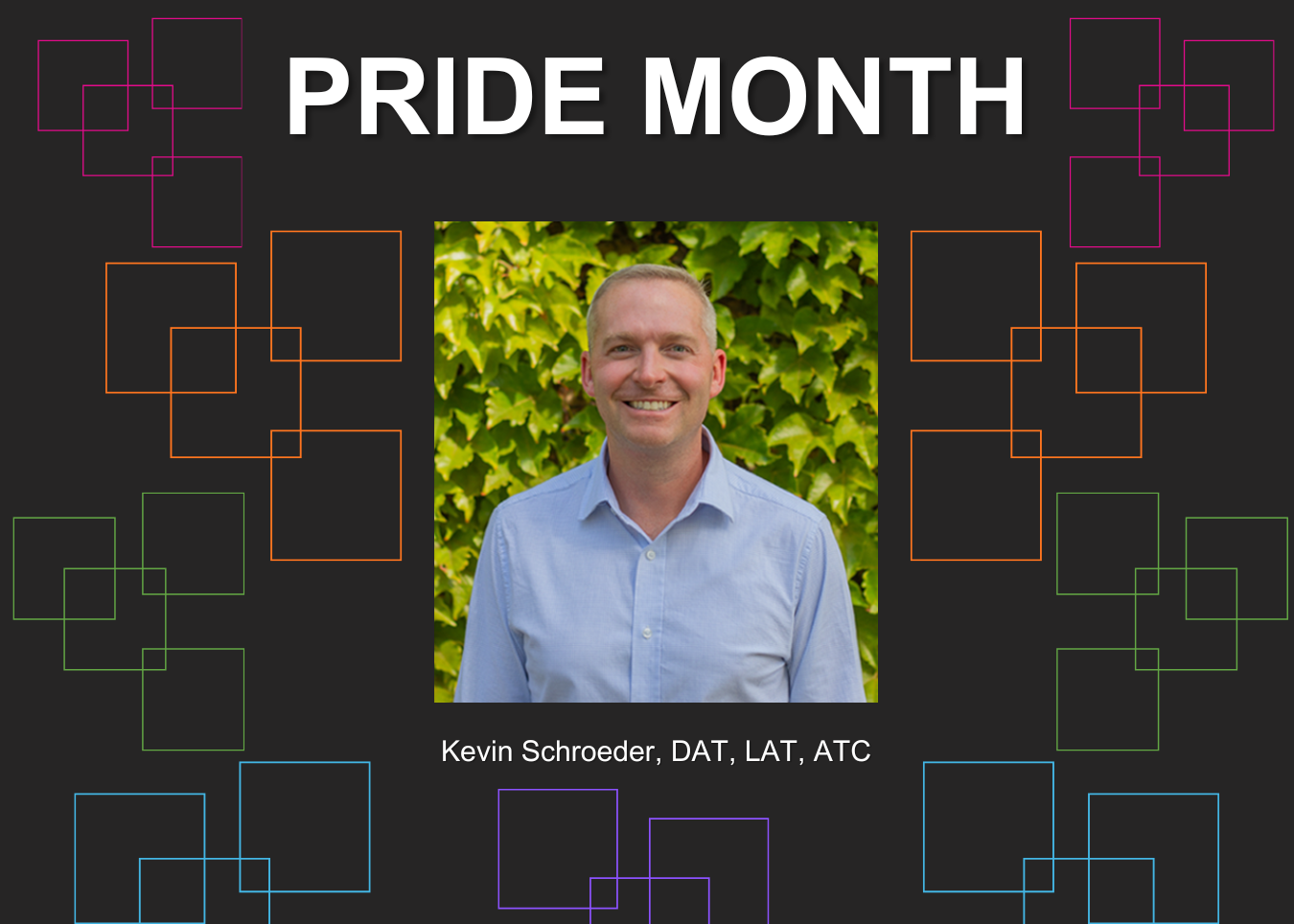
In honor of Pride Month, throughout June, NATA Now is highlighting members of the NATA LGBTQ+ Advisory Committee and their impact on the profession.
Currently serving as the NATA LGBTQ+ Advisory Committee District Seven representative and New Mexico Athletic Trainers’ Association vice president, Kevin Schroeder, DAT, LAT, ATC, has focused much of his work on supporting marginalized communities, creating opportunities for professional growth and helping athletic trainers feel seen and supported.
At the center of Schroeder’s efforts is a deep appreciation for the profession itself.
“Athletic training is the best profession on the planet, and being able to give back to it in meaningful ways has brought me more fulfillment than I ever expected when I first raised my hand to volunteer,” he said.
In this Q&A, Schroeder reflects on the impact of representation in leadership, the relationships he has built through service and why finding community within athletic training has made volunteering so rewarding.
What inspired you to pursue athletic training, and what was the moment you knew this was the profession for you?
My path into athletic training began with a sports injury my freshman year of high school, a spleen laceration that landed me in the care of my school's athletic trainer, Eugene Everett, LAT, ATC (thank you, Coach E!). What started as a recovery became an education. Eugene took the time to show me what athletic training really was, the scope of the profession, the clinical depth and, most importantly, the relationships at the heart of it all. I had never encountered anything like it before, and I was immediately hooked. From that moment on, I knew this was the profession for me, and I have never looked back.
What was your first volunteer position within the athletic training profession and why did you get involved?
My first volunteer role in the profession was as a Board of Certification for the Athletic Trainer exam question writer. I saw a call for exam writers and decided to give it a try. Writing exam questions isn’t exactly the most glamorous work, but what I didn't anticipate was how much it would sharpen me as a clinician and educator. It forced me to revisit foundational concepts I hadn't thought about in years, and that process of going back to the basics made me a better athletic trainer. It also turned out to be unexpectedly practical because that experience laid the groundwork for writing exam questions across every course I've taught since. Sometimes the volunteer roles that seem the smallest end up giving you the most.
Tell us about your current volunteer position and what you hope to accomplish in this role.
I currently serve in two volunteer roles: as the District Seven representative to the NATA LGBTQ+ Advisory Committee, and as vice president of the New Mexico Athletic Trainers' Association.
Queer representation in this profession matters deeply to me. Athletic training has historically existed in spaces that haven’t always been welcoming to queer individuals, and there are real, unique challenges that come with that. I've been fortunate to have had tremendous support from colleagues throughout my career who allowed me to show up as my full self, and that experience has shaped my commitment to doing the same for others. A significant focus of my scholarship is now centered on marginalized communities, including those who identify within the LGBTQIA+ spectrum. Over the years, I've had the opportunity to publish and present on these topics to a wide range of audiences, always with the goal of helping providers – athletic trainers and beyond – better understand the distinct health care needs of queer-identifying individuals.
The VP role came about a little differently. I've always had a passion for the political side of the profession, so when I was asked to consider running, I took a chance on something new. I had never held an elected position quite like this before. It has been one of the most rewarding decisions I've made. As VP in NM, overseeing the annual clinical symposium has allowed me to lean into my identity as an educator, and the role has opened doors to stakeholders and conversations I never anticipated. When my time on the board comes to an end, my hope is simply that the athletic training profession in New Mexico is in a better place than when I started.
Why is representation in leadership important and how does it impact the profession?
The moment it truly hit me was my second day working as an athletic trainer for a Special Operations Air Force squadron. It was an environment unlike anything I had experienced before, personally or professionally, and the absence of representation was immediately apparent. I was fortunate, again, to be surrounded by colleagues who were supportive and allowed me to be myself. But serving as a queer-identifying athletic trainer in that setting came with real challenges. I found myself constantly in the role of educator, helping those around me understand experiences and perspectives that were simply unfamiliar to them, all while doing my job and showing up for the people in my care.
That experience changed me. It helped shape who I am as an athletic trainer, as an advocate and, ultimately, as a scholar. It's part of what grounds my work in social accountability, the idea that the profession has a responsibility to reflect and serve the full diversity of the communities we work within. When people in leadership look like, live like and love like the people they serve, it signals belonging. It opens doors. And it means the decisions being made at the table actually account for the full picture. Representation is not just symbolic. It’s structural, and the profession is better for it when we get it right.
How has volunteering helped you grow personally and professionally?
Volunteering has become an outlet that connects me to parts of the profession I would otherwise never encounter. Through my work with NATA, BOC and Commission on Accreditation of Athletic Training Education, at the state, district and national levels, I have met some of the most wonderful people – colleagues I have never worked with clinically, but who have become genuine friends. That alone has made every hour of service worth it.
Professionally, I have found deep joy in working alongside like-minded people to find ways to move the profession forward. People I never would have crossed paths with otherwise. There is something energizing about sitting in a room or being on a call with others who share your passion and your commitment and realizing that together, you can actually make something better. At the end of the day, I simply love this profession. Athletic training is the best profession on the planet, and being able to give back to it in meaningful ways has brought me more fulfillment than I ever expected when I first raised my hand to volunteer.
What’s your fondest memory of serving so far?
I have so many meaningful memories from my time volunteering in this profession that choosing just one feels almost unfair. But one that stays with me often is watching the successful completion of the first in-person state association meeting I helped oversee come to a close. Seeing colleagues from across New Mexico (and a few from out of state) come together to learn, grow and share space with one another was one of the greatest joys of my professional career. There is something about witnessing a community show up for itself that is hard to put into words. It reminded me, in the best possible way, that I genuinely have the best job in the world.
What advice do you have for other athletic trainers who want to give back to the profession?
Being an athletic trainer comes with its ups and downs – that's just the reality of this work. But finding your people makes all of it worth it. My advice is to find something you love about this profession and make it your own. When you do, you will naturally find yourself surrounded by like-minded people who want to help you do good work and who share your passion for moving things forward. Those people will also become your community, the ones who refill your proverbial cup when things get hard. And athletic training can be hard sometimes. Having that support system, built through service and shared purpose, makes all the difference.