A Lasting Legacy of Service
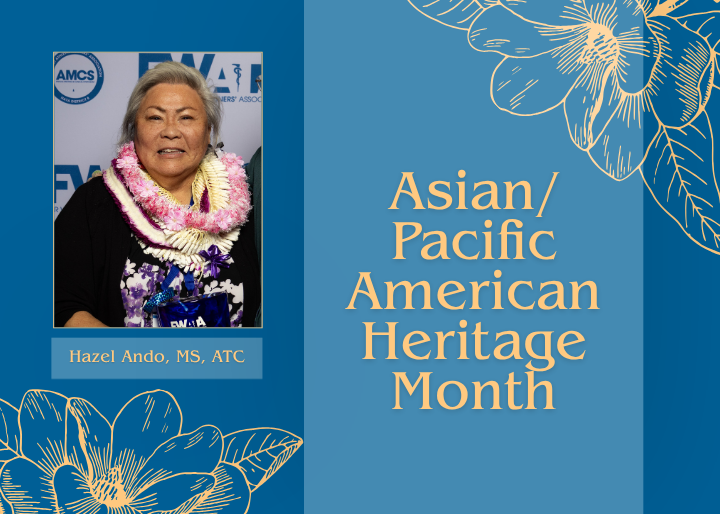
In honor of Asian/Pacific American Heritage Month in May, NATA Now, in collaboration with the NATA Ethnic Diversity Advisory Committee, is highlighting some of our Asian American and Pacific Islander leaders making an impact at the state, district and national level.
From serving as secretary and president of the California Athletic Trainers’ Association to helping lead convention programming, legislative efforts and scholarship initiatives, the volunteer résumé of Hazel Ando, MS, ATC, reflects a lifelong commitment to supporting athletic trainers and creating opportunities for future generations.
Ando’s athletic training journey began in the 1970s during her time as a student at Long Beach State and Eastern Kentucky University. Thanks to her mentors, she found herself drawn not only to the profession itself, but also to giving back to it.
“As I gravitated to volunteering with my community and various areas of athletic training, it helped me meet colleagues I would never meet,” she said.
Since becoming CATA secretary in 1986, she has continued to serve in numerous leadership and committee roles at the state, district and national levels, including work with the NATA Convention Education Program Committee, the CATA Legislative Action Committee and various Far West Athletic Trainers’ Association committees supporting scholarships, education, convention programming and honors and awards.
Along the way, she and her family have funded the FWATA District Eight Mark Ando/Ito Family Scholarship for students of Asian descent, helping support more than 18 students pursuing careers in athletic training.
In this Q&A, Ando reflects on the mentors who shaped her career, the value of representation in leadership and why volunteering continues to be one of the most rewarding parts of her professional journey.
What inspired you to pursue athletic training, and what was the moment you knew this was the profession for you?
My first introduction to an athletic trainer was in 1973 when I was on the Long Beach State’s JV volleyball and basketball teams. I didn’t have an injury, but we were required to have our ankles taped. I was interested in going into medicine and found that an athletic trainer had the best of the two worlds – medicine and sports. It would also be less expensive than going into medical school.
What was your first volunteer position within the athletic training profession and why did you get involved?
I had gone to grad school at Eastern Kentucky University and worked with Bobby Barton, AT Ret., who was the NATA president. I saw how dedicated Dr. Barton was to the profession. I met many of the leaders in the profession – Otho Davis, Mary at the NATA office – and many colleagues who were volunteering in various positions across the nation during my stay at EKU. They were passionate about improving the profession for the future generation as more women were joining as certified ATs. When I started at EKU, Dr. Barton allowed me to help at football practices. The morning of the first home game, he called that I would be allowed to be on the field as the president of the school and head football coach approved. I wasn’t aware that no female has been allowed to be on the football field. I returned to California thinking I would like to serve in some capacity with our state association after being around those who served NATA. My volunteer journey began as the CATA secretary in 1986, and since that time, I have been serving in some capacity with the state and district.
Tell us about your current volunteer position and what you hope to accomplish in this role.
I am currently on the Far West Athletic Trainers' Association Honors and Awards Committee as a member and the awards reception coordinator with the FWATA Annual Meeting & Clinical Symposium Committee. The goal is to recognize deserving district members. During our Annual Meeting & Clinical Symposium, I want to provide an atmosphere where our attendees can be part of the special celebration to honor each awardee. I remember sitting at the NATA Hall of Fame luncheons and was inspired by each Hall of Fame inductee’s stories of their careers.
Why is representation in leadership important and how does it impact the profession?
Leaders are key in being involved in decisions and the future of the diverse profession. I have been fortunate to have leaders/mentors who served by example and considered the importance of serving the members of their area. In my limited role of being a leader, I strived to be open-minded and made decisions that would benefit the growth of the members.
How has volunteering helped you grow personally and professionally?
Growing up I was quiet and on the shy side but always willing to help out when needed. My grandparents and parents instilled in all of us that it’s important to volunteer whenever possible. As I gravitated to volunteering with my community and various areas of athletic training it helped me meet colleagues I would never meet as well as be involved with international events, such as serving on the USA delegation at the many Summer World University Games around the world.
What’s your fondest memory of serving so far?
There are several fond memories. First, I have been able to fund the FWATA Mark Ando/Ito Family Scholarship to 18-plus students and it brings me great joy to see the majority have continued in the profession and with some serving in various capacities with our state and district associations. Second, being involved with the FWATA Annual Meeting & Clinical Symposium Committee for 20-plus years, I have made many lifelong friends. I am especially grateful for Bill Chambers and Andy Paulin’s leadership on this committee and their dedication to our profession. Lastly, receiving the FWATA Bill Chambers’ Lifetime Achievement Award was an honor as a culmination of my years of service. This award is dedicated to all the athletic trainers who I met along the way, and I’m thankful to my husband, Leroy Heu, MA, ATC, and my family.
What advice do you have for other athletic trainers who want to give back to the profession?
Start with an area you feel comfortable in serving within and the amount of time you can volunteer. If you are interested in a specific area, contact the appropriate person or committee. Every session, symposium or large event needs volunteers. I thank all the students and certified volunteers who have helped me provide athletic training services during the annual Nikkei Games Basketball Tournament that runs eight courts, 3-on-3 games for two days for ages 5 to 70 for the past 20 years.