Four Decades of Giving Back
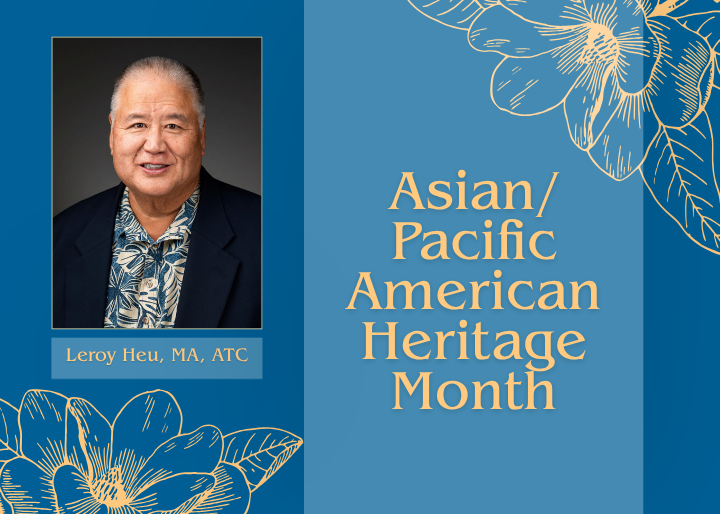
In honor of Asian/Pacific American Heritage Month in May, NATA Now, in collaboration with the NATA Ethnic Diversity Advisory Committee, is highlighting some of our Asian American and Pacific Islander leaders making an impact at the state, district and national level.
For many athletic trainers, volunteering starts as a way to find connection but, over time, becomes something more. Leroy Heu, MA, ATC, is one such AT.
From his early volunteer role as a Board of Certification examiner to his current efforts supporting the FWATA Annual Meeting and Clinical Symposia, Heu’s experience spans decades within the profession. Along the way, he’s built relationships, supported his peers and contributed to opportunities that benefit the broader AT community.
“Leadership started as an athletic training student with great mentors to learn from,” he said. “[My mentors] were always encouraging me to assist others and serve as a mentor to others entering the athletic training profession.”
Now, more than 40 years into his career, he shares how volunteering has shaped his professional path and why getting involved, at any level, can make a lasting impact.
What inspired you to pursue athletic training, and what was the moment you knew this was the profession for you?
My general interest in sports and athletics while in high school. I had an injury that didn’t allow me to participate in high school football. George Kamau Jr. and Keoki Kamau provided my initial opportunity to become an athletic training student at Farrington High School in Honolulu, Hawaii. This experience allowed me to attend San Jose State University under the leadership of Jim Welsh to start my formal education as an athletic training student under the original NATA internship program. Lindsy McClean and Hal Wyatt provided me with the next opportunity to serve as a camp/seasonal assistant with the San Francisco 49ers. I was hooked to continue with this profession after these experiences.
What was your first volunteer position within the athletic training profession and why did you get involved?
Upon certification in 1984, I first volunteered with the Board of Certification Examination as an examiner. Initially served as an examiner model, leading to a regular examiner and eventually becoming a site coordinator, which is no longer the current BOC certification process. I felt this was my start in being involved with fellow ATs in the California Bay Area and a great way to start networking.
Tell us about your current volunteer position and what you hope to accomplish in this role.
I am assisting my fellow FWATA Annual Meeting and Clinical Symposia Committee members. My role is to assist with the coordination of the FWATA AMCS Exhibitor Expo and Showcase. I am the liaison seeking interested vendors to exhibit their product or services to the membership at the AMCS. I hope to provide the membership a variety of vendors with the latest products and innovations in the athletic training profession. My main goal is to serve and assist the membership with their needs throughout the AMCS.
Why is representation in leadership important and how does it impact the profession?
Leadership started as an athletic training student with great mentors to learn from. These individuals molded my development and were a great influence thus making an impact early in education in developing my skill sets and understanding the profession. They were always encouraging me to assist others and serve as a mentor to others entering the athletic training profession.
How has volunteering helped you grow personally and professionally?
I have been in this profession for 40-plus years, which allowed me to network with many fellow ATs locally and internationally over the years through a working experience or a volunteering opportunity. Hard work with some recognition allowed me to serve as a medical coordinator for athletic training services for Team USA and the USA delegation at numerous Federation of International Sports Federation (FISU) World University Games (WUG) since 2009.
What’s your fondest memory of serving so far?
My international experience serving as the lead AT for the USA delegation at the FISU WUG is my greatest moment of my career. The opportunity to travel throughout the world and having the opportunity to understand the variety of medical care available worldwide. Experiencing the FISU WUG opening ceremony parade of nations (similar to the Olympics) gave me the chills entering stadium and representing U.S.
What advice do you have for other athletic trainers who want to give back to the profession?
I recommend everyone to continue to work hard and enjoy your experiences as an AT. Leadership and networking among your peers and mentors are ultimately important. Start from local professional setting then leading on to greater experiences to make a difference in our growing athletic training profession.