Class of 2026: Career Origins
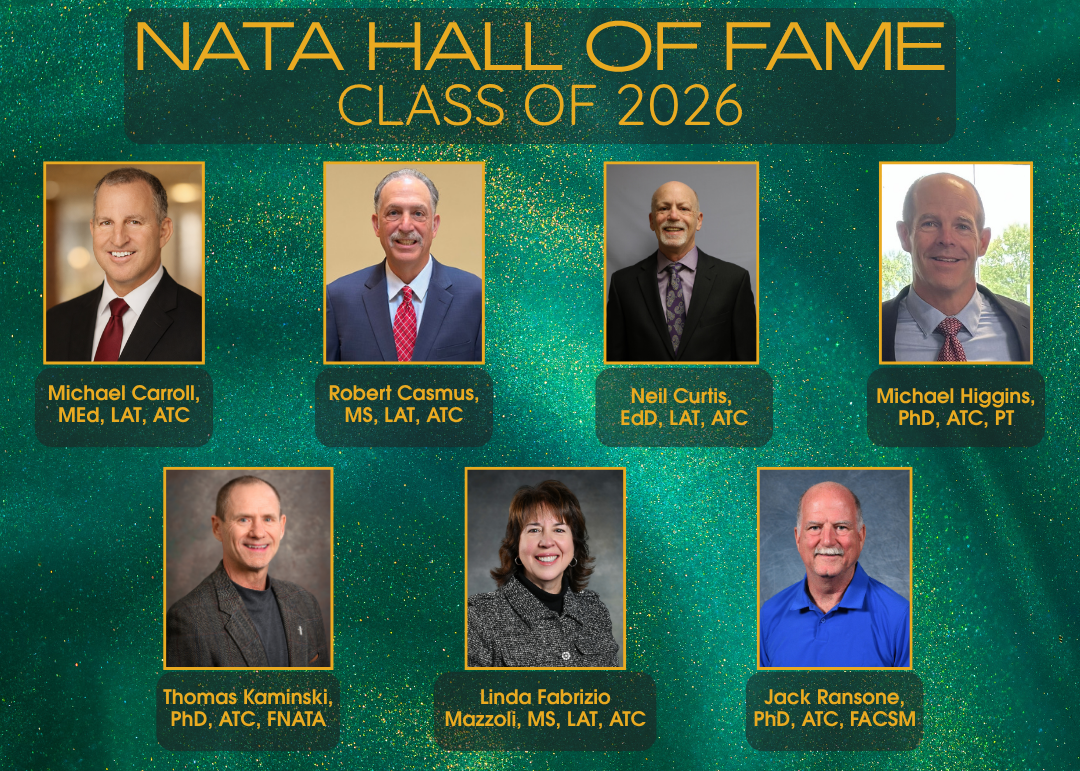
The NATA Hall of Fame represents the highest honor bestowed on members, recognizing those who have shaped the profession through leadership, service and mentorship. Beyond the iconic green jacket and ring, NATA Hall of Fame induction reflects a lifelong commitment to advancing athletic training, supporting future generations of ATs and making a lasting impact on the profession.
The May/June NATA News features profiles on each 2026 NATA Hall of Fame inductee, highlighting their career journeys, volunteer service and influence as leaders. The class of 2026 will be inducted during the 77th NATA Clinical Symposia & AT Expo in Philadelphia. Don’t miss the NATA Hall of Fame Induction & National Award Ceremony at 1 p.m. June 30.
In this post, the inductees share insight into why they decided to pursue a career in athletic training.
Michael Carroll, MEd, LAT, ATC
My father was a medical doctor and my mother was a nurse, so I grew up around health care. When I was in high school, I was a very average athlete, but I loved sports and my best friend was an athletic training student aide. My high school had an athletic trainer, so I started working with him. I instantly fell in love with the profession as a way to integrate athletic health care and be around sports. My next-door neighbor in my hometown was a scholarship football player for Texas A&M University, and he introduced me to Karl Kapchinski, LAT, ATC, who was the head athletic trainer at Texas A&M. I was offered a spot in their program. Once I enrolled as a student at Texas A&M, I had Frank Walters, PhD, LAT, ATC, as my athletic injuries professor as well as many other classes in the athletic training curriculum. I love being able to help athletes stay healthy or return them to full activity if they become injured. I have so many friends who say they wish they were in any profession other than what they are in. I’ve never said, “I wish I hadn’t gone into athletic training.”
Robert Casmus, MS, LAT, ATC
I was always interested in the medical field since high school and enjoyed playing sports, but wasn’t very talented. Athletic training was the ideal way to combine a passion for sports and medicine and become part of something bigger than myself.
Neil Curtis, EdD, LAT, ATC
As a sophomore at Boston University, I took a required course taught by athletic trainer Nick Passaretti. It was the first time I heard of the profession and job of an athletic trainer. I quickly realized athletic training was my future career path and began the internship route to BOC certification.
Michael Higgins, PhD, ATC, PT
In 1982, when I was a senior in high school, someone advised me to pursue dual credentials in athletic training and physical therapy. Because I loved sports, working out and understanding how the body functions, the suggestion made perfect sense. In hindsight, it was some of the best advice I ever received. Doing this allowed me to explore health care in a variety of settings, which ultimately helped me realize that athletic training was the perfect fit, combining all the things I was most passionate about.
Thomas Kaminski, PhD, ATC, FNATA
As a middle school student, I began volunteering my time as the manager of our high school – Fredonia School District – football team, which continued throughout my high school tenure. I was fortunate that our head football coach, David Ball, taught me how to tape ankles and perform various wrapping and strapping techniques during my time as a manager. Most importantly, he introduced me to the Cramer First Aider publication that I would read cover to cover each month it arrived. From that point I was hooked, and I was fortunate to have had a terrific undergraduate education in Sports Medicine at Marietta College under the tutelage of my long-time mentor Paul “Doc” Spear, AT Ret.
Linda Fabrizio Mazzoli, MS, LAT, ATC
I often say the athletic training profession pursued me as I wasn’t privileged to have any knowledge of athletic training even though I played multiple varsity sports. My high school didn’t have ATs on campus or the league in which we participated. I went to college orientation and selected athletic training as a course because I thought I would be “training” athletes. It wasn’t until I was playing varsity soccer freshman year that I was introduced to the athletic training graduate assistant. It was only then that I learned the truth about the field I picked to study. I became intrigued and challenged myself to learn innovative ways to keep athletes healthy and performing at their highest levels. That pursuit ignited a spark in me and shaped my commitment to ensuring that all athletes and participants had the opportunity to know, understand and fully utilize athletic trainers for their health and well-being.
Jack Ransone, PhD, ATC, FACSM
I pursued athletic training because I have always been deeply interested in performance and exercise metabolism. As I worked toward becoming a Division I wrestler, I experienced a significant setback when I dislocated my shoulder. That injury led me to spend a great deal of time in the athletic training facility, where I observed firsthand the critical role athletic trainers play in both individual patient care and the overall team dynamic. That experience shifted my path; as I developed professionally, I became increasingly driven to expand my knowledge of therapeutic rehabilitation and performance optimization. I sought out new opportunities that allowed me to grow, eventually helping to establish medical services for USA Wrestling and later for USA Track & Field.
Committed to lifelong learning, I pursued a PhD in physiology and, for the past 40 years, have set out to learn at least one new concept or skill each year. These experiences have continually strengthened my clinical practice, educational approach and ability to share knowledge with others.