Guiding Others, Growing Herself
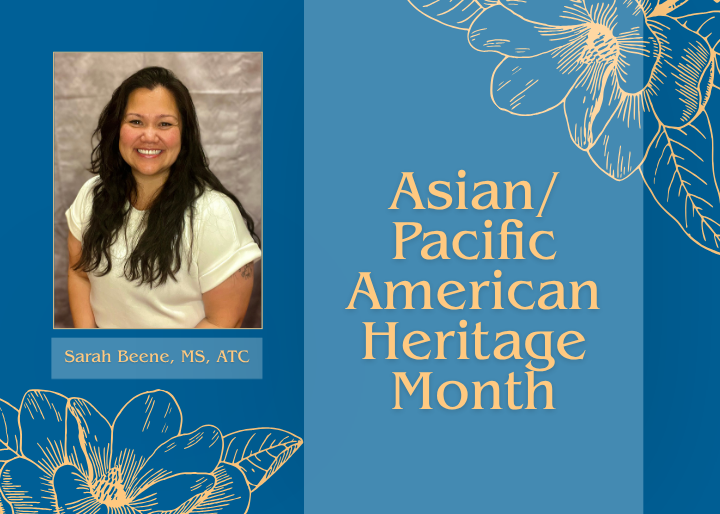
In honor of Asian/Pacific American Heritage Month in May, NATA Now, in collaboration with the NATA Ethnic Diversity Advisory Committee, is highlighting some of our Asian American and Pacific Islander leaders making an impact at the state, district and national level.
Mentorship can have a lasting impact – just ask Sarah Beene, MS, ATC. Not only did early influence from experienced ATs encourage her pursuit of the profession, it also led to an early interest in volunteer leadership.
As relationships within the profession grew, so did opportunities for Beene to contribute, first as a member of the Far West Athletic Trainers’ Association Early Professionals/Career Advancement Committee, then as an advisor for the FWATA Student Leadership Committee before eventually getting involved with the Annual Meeting and Clinical Symposium Committee.
“Looking back, so much of my involvement grew through building relationships and just being around and available to help,” she said.
“Volunteering has helped me create meaningful connections with others outside of the traditional workspace and taught me to approach situations considering different perspectives, while allowing me to create experiences that positively impact our community.”
In this Q&A, Beene reflects on those who guided her into athletic training and volunteer leadership, and how those relationships continue to influence her approach to service within the profession.
What inspired you to pursue athletic training, and what was the moment you knew this was the profession for you?
Leroy Heu, MA, ATC, and Nina Hsieh, MS, ATC, CSCS, brought me on as an intern at University of California at Santa Barbara during my senior year of undergrad and I immediately fell in love with the job. I had the opportunity to learn from the UCSB sports medicine staff as they provided a steady presence to their patients, helping them through their seasons and the process of being injured. There’s something incredibly meaningful about being the person who can bring calm, clarity and direction when things are chaotic or uncertain. I also appreciated that we got to help someone through some of their hardest moments, while helping them pursue something they love. Athletic training allowed a perfect mix of health care, problem solving, performance and genuine connection with others and allowed them all to exist in the same space.
What was your first volunteer position within the athletic training profession and why did you get involved?
While I was at California Baptist University for graduate school, I volunteered at the registration tables during the FWATA Annual Meeting & Clinical Symposium in San Diego. I loved the energy of meeting new people and getting introduced to the larger athletic training community in such a hands-on way. Since networking never came naturally to me, it also gave me a low-stress way to connect with others while stuffing packets or signing people in.
Later, during one of my first years attending the Annual Meeting as a certified athletic trainer, I stopped by to say hello to Hazel Ando, MS, ATC, and casually asked if she needed help with anything. Hazel invited me to assist with the slideshow for the Honors and Awards Banquet that year, and I’ve helped with it ever since. That experience opened the door to Junior Domingo, MS, ATC, suggesting I apply to serve as an advisor for the Student Leadership Committee, and eventually becoming involved with the Annual Meeting and Clinical Symposium Committee. Looking back, so much of my involvement grew through building relationships and just being around and available to help.
Tell us about your current volunteer position and what you hope to accomplish in this role.
I currently serve as the special events coordinator for the FWATA Annual Meeting and Clinical Symposium Committee, where I help coordinate many of the attendee engagement events that take place throughout the week. When on-site, I also help serve as a liaison between our committee and the hotel event staff, helping navigate day-to-day logistics of events and meeting spaces. One of my favorite parts of the role is helping create spaces where people can connect, and I hope to continue contributing to an environment where members feel welcomed, engaged and excited to be part of the District Eight community.
Why is representation in leadership important and how does it impact the profession?
Leadership is where priorities are set, decisions are made and the future of the profession is shaped. When leadership reflects the diversity of the membership it serves, it brings a wider range of experiences, perspectives and ideas into the conversation, leading to more thoughtful and inclusive decision-making. Seeing leaders who understand, represent and value different perspectives and lived experiences helps others feel seen, supported and confident that there is space for them to grow and lead as themselves. In a space where we work with diverse populations and complex human situations every day, open-minded leadership helps us better care for not only each other as professionals, but also the patients and communities we serve. The strongest organizations are the ones willing to listen to different perspectives, evolve and make room for more voices at the table.
How has volunteering helped you grow personally and professionally?
Volunteering has helped me create meaningful connections with others outside of the traditional workspace and taught me to approach situations considering different perspectives, while allowing me to create experiences that positively impact our community. I have always loved event/party planning, even before I got into the profession, and now getting to combine my passion with a profession I love has been especially rewarding.
What’s your fondest memory of serving so far?
During one of my last events as an advisor for the Student Leadership Committee, our Annual Meeting subcommittee wanted to create an event that encouraged genuine engagement between students, mentors and professionals. Our subcommittee created a “scavenger hunt” that brought together small groups of students and mentors, and created challenges to accomplish across the site. They took photos, interacted with FWATA Hall of Fame members and provided thank you notes to other volunteer members. It was so rewarding to watch this event, seeing interactions evolve and students building confidence and relationships in real time.
What advice do you have for other athletic trainers who want to give back to the profession?
Start somewhere. Meet new people, ask them about what they do, and see if they need help with something. Many of us got involved by just being available to help, and eventually we found something that we connected with. You may not find exactly what you love right away, but you will gain something from each experience. There are so many ways to give back, so explore what works for you and what helps you feel fulfilled; you’re more likely to keep volunteering and your passion will bring others in, too. Every bit of what you give back is meaningful, no matter how small it may seem.