If Not Me, Then Who?
Your journey as an athletic trainer doesn’t stop when you earn your credential. It grows stronger with the support of your professional home. This membership renewal season, NATA Now is sharing how ATs of all career stages have found home at NATA and embody this year’s campaign, “I am NATA.” Join or renew your membership for 2027 now.
By Leona Scott
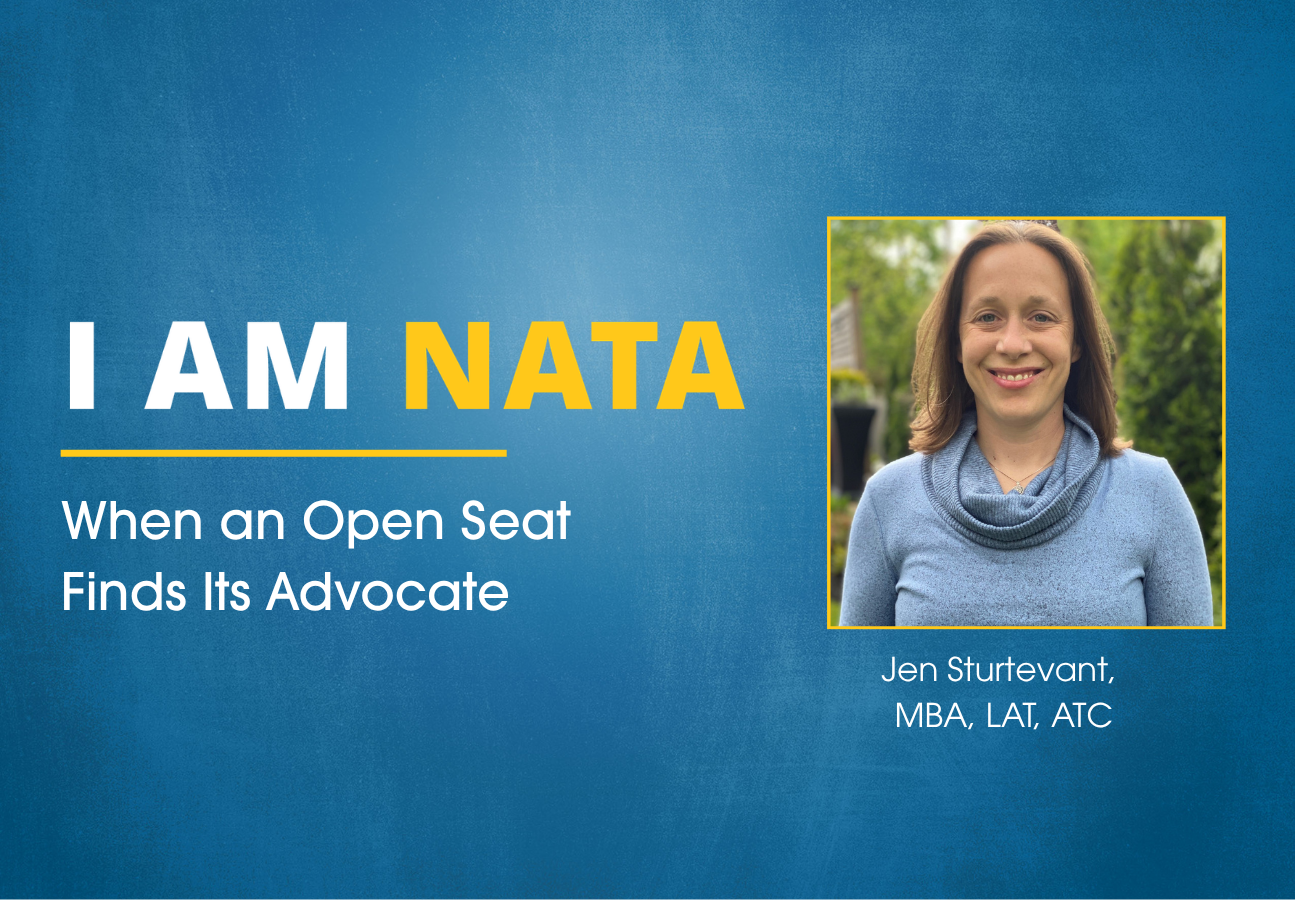
In the spring of 2018, Jen Sturtevant, MBA, LAT, ATC, came across a post announcing that the NATA LGBTQ+ Advisory Committee had just become an official committee. Every district seat had been filled but one. The committee still needed its first-ever District One representative.
“I was like, ‘Really? Wow! There’s an LGBTQ+ committee,’” said Sturtevant, who works in Massachusetts. “This is amazing, because I personally identify … I am part of that community. I’d always been an advocate in my own workspace and in my own life, but I’d never thought about it in terms of the overall profession.”
Nobody was tapping her on the shoulder. But she asked a couple of longtime athletic trainers, and they encouraged her to move forward.
She interviewed with then-District One Director Diane Sartanowicz, MS, LAT, ATC, and the committee’s first chair, Pat Aronson, PhD, ATC, and was selected.
“I was like, ‘Oh my God, I’m actually doing this!’” she said.
That leap set the course for everything that followed. A NATA member for 20 years, Sturtevant went on to chair the LGBTQ+ Advisory Committee and now chairs the NATA Diversity, Equity, Inclusion and Access Council. She is program manager of sports medicine for Tufts Medicine at MelroseWakefield Hospital, where she oversees an outreach athletic training program serving local high schools, which is a role that includes serving as athletic trainer at Malden High School.
From Member to ‘Wow’
For years, membership was simply what you did. Sturtevant’s college professors and clinical instructors were NATA members who encouraged students to join.
“I was just a member who would access some of the resources here and there,” she said. “I was following along with my mentors and doing what they were doing.”
That changed in New Orleans. Her new committee had met only by phone conference, so Sturtevant knew her fellow members as voices on the line. The 69th NATA Clinical Symposia & AT Expo in 2018 was the first time they gathered in person.
“I walked into our first committee day meeting and I was like, ‘What am I doing here? I don’t belong,’” she said. “These people were leaps and bounds ahead of where I could have even wanted to be at that time. I was in awe. It opened up a whole new world.”
The People Who Paved the Way
Sturtevant’s list of mentors is long. It starts at Salem State College, her alma mater, with her clinical coordinator, Amy Everitt, EdD, LAT, ATC, and the late Bill Bulloch, then the head athletic trainer. They brought students to conferences, introduced them to people and showed them why membership mattered.
Sartanowicz, whom Sturtevant first met through a Massachusetts Department of Public Health advisory group on sport concussions, was one of the first people she called when she wanted to volunteer and has been a big supporter ever since. Locally, she credits colleagues including Jen Brodeur, MS, LAT, ATC, Julie Alexander, MSEd, ATC, and Vicky Graham, DAT, LAT, ATC. Through committee work, she credits Rebecca Lopez, PhD, LAT, ATC, and others.
But Aronson’s leadership left the deepest mark.
“Even when we would hit barriers – when it felt like we just weren’t getting anywhere – she was right there,” Sturtevant said. “She showed that it was OK to speak up, to challenge and ask the questions and keep pushing. And she did it with such enthusiasm, always finding the positive and keeping us grounded.”
A Voice for Others
In 2018, a charged time for the LGBTQ+ community, Sturtevant was already heavily involved in advocacy work within her own organization. The new committee offered a chance to bring that experience to the entire profession.
“I felt like I had a responsibility, because if not me, then who else?” she said. “I wanted to take on that challenge of being that voice for others who maybe don’t have the support or the access.”
One opportunity led to the next: committee chair, a term on the NATA Research & Education Foundation board and now the DEIA Council, which brings her into NATA Board of Directors meetings.
“All these opportunities have helped me build my skills as a professional and as a leader,” she said. “Now I want to help build and encourage others, just as was done for me.”
What ‘I Am NATA’ Means
To Sturtevant, “I Am NATA” means ownership, connection and responsibility.
“I would not be where I am professionally or even personally without this experience,” she said. “I’ve developed amazing professional relationships and lifelong friendships through this work.”
And she rejects the idea that the association is something that happens to members.
“We are the organization,” she said. “It’s not a group of people sitting at the top making decisions. Those people on the board, all of us serving on committees, we are members. We have the ability to shape the association and how it moves forward.”
Her one regret? That her involvement didn’t start sooner. Her advice: Don’t wait for an invitation.
“Step out of your comfort zone and take that first step,” she said. “Even if you don’t have somebody tapping you on the shoulder; if you see something you’re interested in, raise your hand. I think you’d be really glad you did.”
She shares the same message with the high school students she works with as they weigh college choices. Sturtevant didn’t land at her top pick, but she made it the best experience she possibly could.
“Being part of NATA can be what you want it to be,” she said. “It’s up to you to create that.”