Stepping Up to Service
Your journey as an athletic trainer doesn’t stop when you earn your credential. It grows stronger with the support of your professional home. This membership renewal season, NATA Now is sharing how ATs of all career stages have found home at NATA and embody this year’s campaign, “I am NATA.” Join or renew your membership for 2027 now.
By Leona Scott
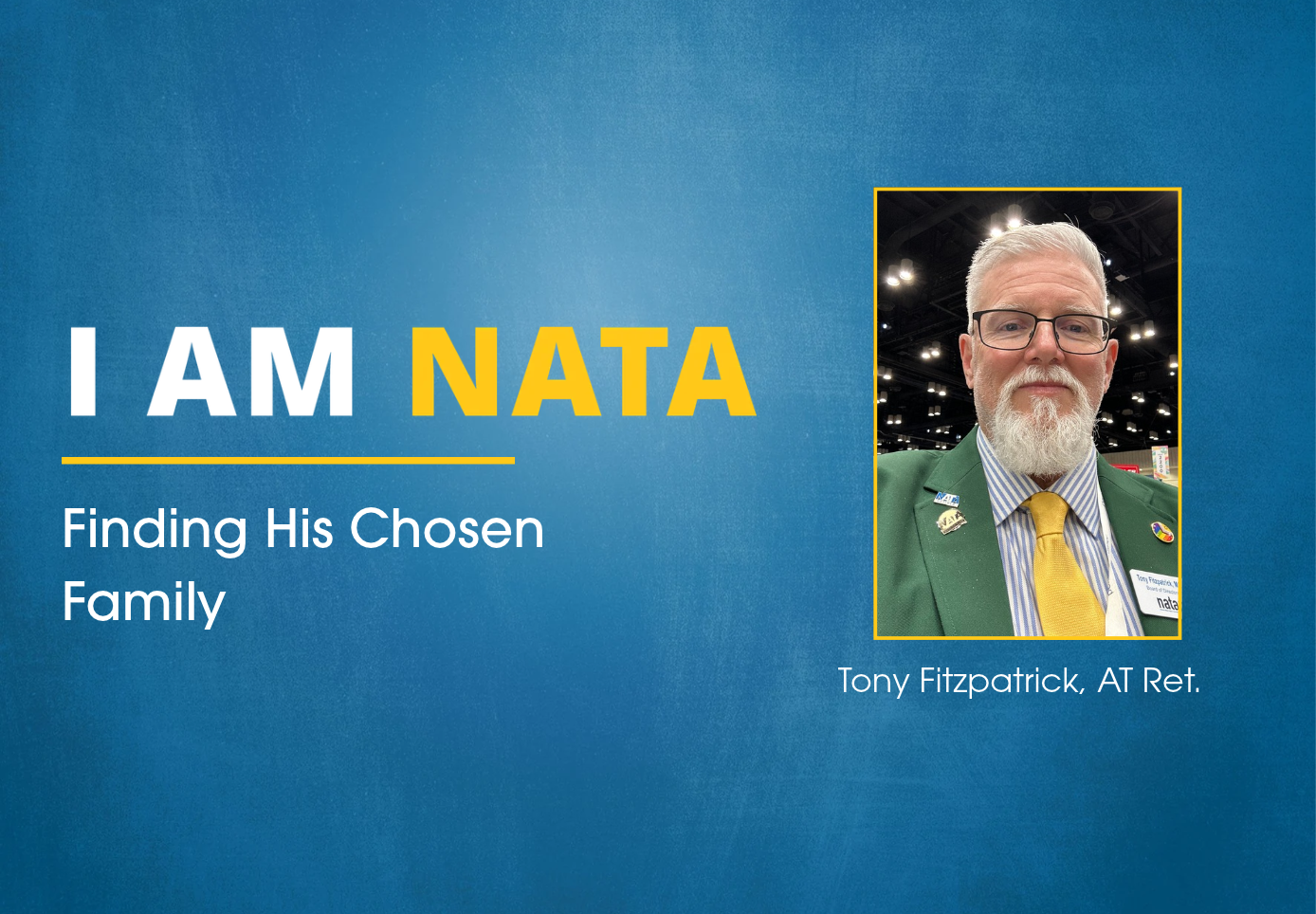
Tony Fitzpatrick, AT Ret., still talks with his NATA family almost every day.
They’re the colleagues he met years ago on the NATA Secondary School Athletic Trainers’ Committee. They’re the athletic trainers from across the country who became, in his words, his work family and then his chosen family. Together, they’ve shared graduations, weddings, illnesses and losses. When he needs advice, they’re a phone call away.
“That’s really when it struck me that NATA was more than just a professional association,” Fitzpatrick said. “It became a family association: a family of athletic trainers all working toward a common goal of advancing athletic training.”
Fitzpatrick was inducted into the NATA Hall of Fame in 2023, the same year he retired after 35 years as a teacher and athletic trainer in the Boise School District, most recently at Timberline High School. He was District Ten treasurer from 2009-13 and served on the NATA Board of Directors as District Ten director from 2017-22, including as vice president in 2021-22. He has served on more than 30 NATA-related committees. Today, he serves on the NATA Honors and Awards Committee and as District Ten director on the NATAPAC Board of Directors.
He no longer practices. But he hasn’t stopped serving.
Finding His People
NATA first felt like home when Fitzpatrick was chosen to represent District Ten – comprised of Alaska, Idaho, Montana, Oregon and Washington – on SSATC from 2002-08. It was his first national role, and it turned out to be “so much more than I ever anticipated.”
Several of his fellow committee members, like Fitzpatrick, would go on to be inducted into the NATA Hall of Fame.
“They weren’t Hall of Famers when we were in secondary schools, but you could see at the time they were Hall of Fame athletic trainers just by being in their presence,” he said. “That’s when I knew I was with some very special people.”
Like any family, they didn’t always agree.
“Every child, every parent is going to have a different opinion,” he said. “You’ve got to learn to work through those to come to common ground.”
He found that same spirit years later on the NATA Board of Directors.
“Nobody shrugs it off or says, ‘Oh God, Fitz is talking again,’” he said. “They actively listen and ask intense, deep questions that make you think; they make you a better leader, a better member.”
Following Gary
If one person shaped the kind of athletic trainer Fitzpatrick became, it was Gary Craner, AT Ret., the retired head athletic trainer at Boise State University and one of several District Ten leaders who mentored him.
“I basically followed him around like a puppy,” Fitzpatrick said.
Craner preached servant leadership and believed membership and the profession depend on each other.
“NATA isn’t going to be successful without active athletic trainers, and athletic trainers aren’t really going to be successful if they’re not active within the association,” Fitzpatrick said.
He admired Craner’s humility, his sense of humor, which could disarm any injured athlete, and his knowledge. He also watched how Craner used his network. In the Big Sky Conference, Craner knew every head athletic trainer and could call any of them at a moment’s notice to trade ideas.
“If one was elevating some area, they wanted it elevated across the board, because a rising tide lifts everybody,” Fitzpatrick said. “They were protective of their student athletes, not of their egos.”
His Boise mentors also didn’t sugarcoat things.
“They didn’t fluff me up by telling me what I wanted to hear,” he said. “They told me what I needed to hear.”
Don’t Just Complain, Step Up
Craner modeled service, but Fitzpatrick credits his parents for instilling it.
His father, an ironworker, served as president of his union and walked strike lines, sometimes with young Tony beside him. His mother, a lab technician, volunteered with Cub Scouts and even coached his football team when no other parent would step up.
The lesson stuck: If you don’t like something, do something about it.
That’s why, long before he held a leadership role, Fitzpatrick attended meetings and asked questions. He knows approaching an elected leader can feel intimidating. But he wants members to know leaders welcome it.
“I guarantee you, every single leader in every district of NATA wants members to come up to them,” he said.
What concerns him more is criticism from behind a screen, which he compared to throwing a grenade into a room and walking away. Face to face, he said, “you see the humanity in them,” and you can disagree productively.
The Science, Art and Magic
In retirement, some of Fitzpatrick’s greatest pride comes from watching others grow like the students who came through his athletic training facility and the colleagues he worked alongside.
“There is a science, an art and a magic to being an athletic trainer,” he said.
The science comes from research and from being a sponge at NATA and district meetings. The art is bedside manner such as hugging a student athlete he had just told had likely torn an ACL. Following Craner’s advice, he never promised everything would be all right. Instead, he promised to be there.
The magic is sensing something is wrong before an athlete says a word – the “Scooby-Doo ears” he developed when 35 to 55 students crowded his room after the final school bell.
“Kids would ask, ‘How did you know that, Fitz?’” he said. “That’s the magic of athletic training.”
For Fitzpatrick, it all comes back to people: The mentors who told him the truth, the committee colleagues he still calls and the young athletic trainers he cheers on from afar.
“I’m incredibly proud of what they’re doing,” he said. “I’m extremely proud of their successes.”
That’s what a family does.