It Started With ‘Hi, I’m Kylie’
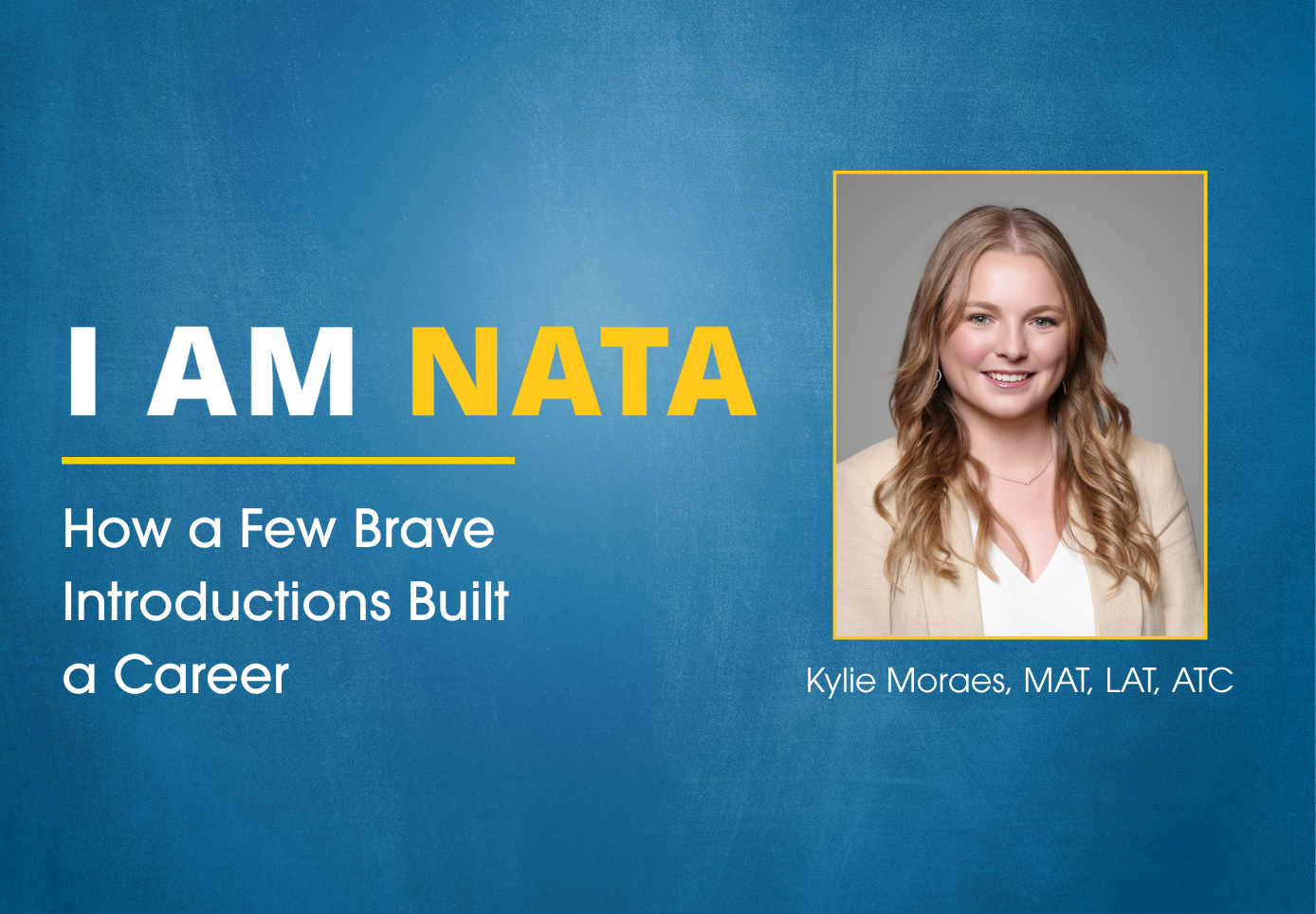
Your journey as an athletic trainer doesn’t stop when you earn your credential. It grows stronger with the support of your professional home. This membership renewal season, NATA Now is sharing how ATs of all career stages have found home at NATA and embody this year’s campaign, “I am NATA.” Join or renew your membership for 2027 now.
By Leona Scott
Kylie Moraes, MAT, LAT, ATC, was 19 years old when she walked up to a stranger at an NATA event and introduced herself.
It wasn’t easy. As a student, she said, you don’t yet know how to navigate professional settings, and approaching an established athletic trainer can be intimidating. But a professor mentioned a friend, Karen Lew Feirman, DHSc, LAT, ATC, who worked with Varsity Spirit, and Moraes, interested in performing arts, found the nerve to say hello.
She didn’t even get Lew Feirman’s contact information. It didn’t matter. When Moraes later joined the NATA Student Leadership Committee, Lew Feirman – now vice president of safety, security and training at Varsity Brands – became her mentor and remembered that first conversation.
“From there, it just grew,” Moraes said.
Today, Moraes is a middle school athletic trainer in Georgetown Independent School District in Texas and the District Six representative on the NATA Early Professionals’ Committee. Looking back, she can trace her path from student to professional through a handful of small, brave moments. And she wants other young athletic trainers to know there’s a place for them, too.
Home From Day One
Moraes knew early what she wanted to do. She discovered athletic training as a high school sophomore and never considered another career.
“I said, ‘This is what I’m doing. I’ve got to figure out how,’” she said.
NATA began to feel like home before she ever held a volunteer role. In January 2019, her district awarded her a scholarship to iLead, a former NATA program that brought students to the association’s Joint Committee Meeting in Dallas that year. There, she met committee members, professionals and students who were already serving. Through a friend who was the district’s SLC representative, she grew close with the committee and set a goal of taking that seat herself when her friend’s term ended.
“I felt at home from day one with all of the professionals I met, all of the students who were also becoming professionals and learning and serving already,” she said.
She reached that goal, serving as the SLC District Six representative in 2020-21.
One Connection, Many Doors
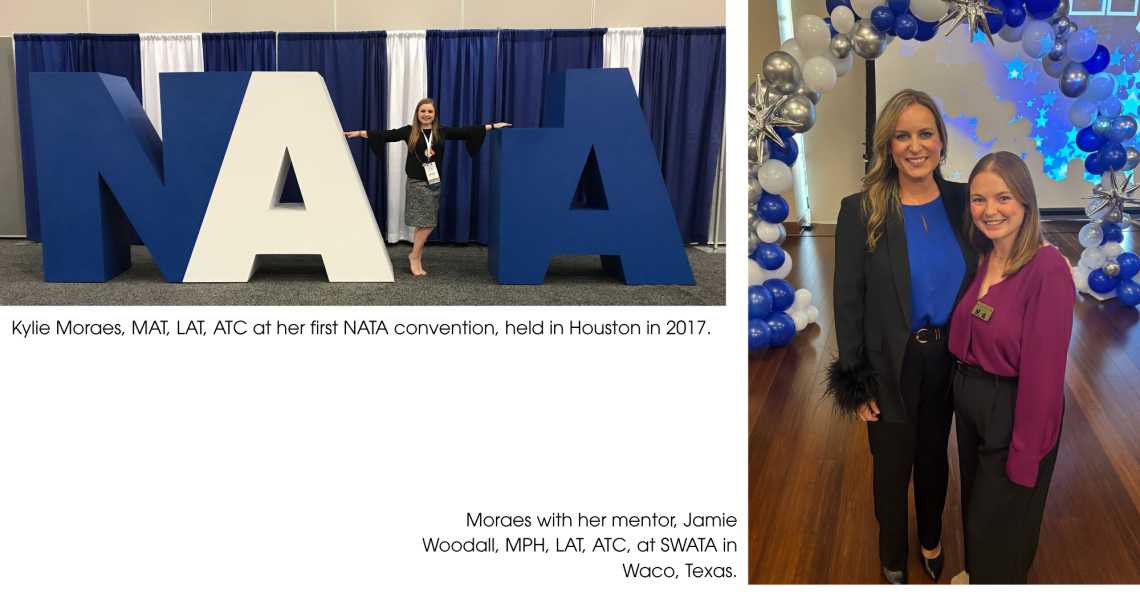
Another introduction proved just as pivotal. At her first NATA convention in Houston in 2017, Moraes approached a speaker from the Southwest Athletic Trainers’ Association, the district where she grew up and now lives and works.
“I just went up to her, and I said, ‘Hey, my name’s Kylie. I’m in SWATA as well. I’d love to talk to you more,’” Moraes said. “I thought nothing of it. … She’s not gonna remember me.”
A month later, at SWATA, the speaker, Jamie Woodall, MPH, LAT, ATC, did remember her. Woodall became Moraes’ mentor and confidant, and the two kept meeting at NATA and SWATA meetings.
That relationship mattered when Moraes needed a secondary school immersion experience. She was the first true “3+2” student in the new entry-level master’s program at Hardin-Simmons University in Abilene, Texas: three years of undergraduate study followed by a two-year master’s degree. She wanted to stay close to home to manage loans and living costs, but she couldn’t find a placement.
Her mentor laughed and offered a simple solution: Why not come to my school?
It was just after COVID-19, and her mentor had moved into more of a leadership role while still working as an athletic trainer. She pushed Moraes to function as a true athletic trainer while still a student, becoming her clinical preceptor, mentor and, eventually, friend. The relationships Moraes built there later helped open the door to her first full-time position at a middle school in Elgin Independent School District.
“It just really paved that way, just through one small connection and one moment of saying, ‘Hi, I’m Kylie, and I’d like to know you better,’” she said.
More Than Clinical Skills
Moraes said her NATA relationships have shaped her not only as a clinician, but as a person.
“We all know how to be athletic trainers,” she said. “But all of my mentors have really poured into me to bring what I have to the table … what makes me special.”
In the secondary school setting, that outside network is especially valuable. When you work alone, or alongside a colleague facing the same pressures, it can be hard to see past the daily challenges.
“Being able to have an unbiased individual that’s not affiliated with your district or your workplace, and they’re able to say, ‘Hey, have you thought about this?’ or ‘Hey, I’ve seen someone do this. Would that help you?’ … that’s extremely valuable,” she said.
Finding Her Spark Again
For Moraes, serving is a way to give back to “the profession and the people who built me.” She learned how much it meant the hard way.
After graduating and leaving SLC, she stepped away from volunteering as she navigated her first job and personal life.
“Without it, I truly just lost sight of how much I loved athletic training,” she said.
When she settled back in Texas and the Early Professionals’ Committee position opened, she returned to service and “found my spark.” Now, she said, it keeps her grounded and keeps her from getting lost in the day-to-day challenges of the job.
The committee’s monthly meetings connect her with athletic trainers across the country she would never have met otherwise. When the committee chair traveled to Austin with her volleyball team, she reached out, and the two met for coffee.
“It gives you a sense of purpose other than self, and that’s grounding,” Moraes said. “But then also, it’s fun to make friends and work alongside them and learn new things all the time.”
There’s a Home for Everyone
Moraes’ advice for young professionals who want to get involved is the same approach that worked for her: Put yourself out there, even when it’s scary, and try to meet one new person every time you’re around other athletic trainers.
“We all started scared. We all started unsure of ourselves,” she said. “We’re all still unsure of ourselves, probably.”
If you feel the pull to volunteer, start anywhere – even with a message to NATA Member Services.
“They will point you in a thousand directions to try and get you plugged in,” she said. “Everybody’s welcome. … Don’t stand in your own way.”
Most of all, she hopes other young professionals feel encouraged to be bold and to be themselves.
“Just because they’re young doesn’t mean that they don’t have value,” she said.
As for what the “I am NATA” campaign means to her personally: “I am NATA because NATA gave me the people and resources in my life to not only be the best AT I can be, but the best person, too.”