Building a More Accessible Profession
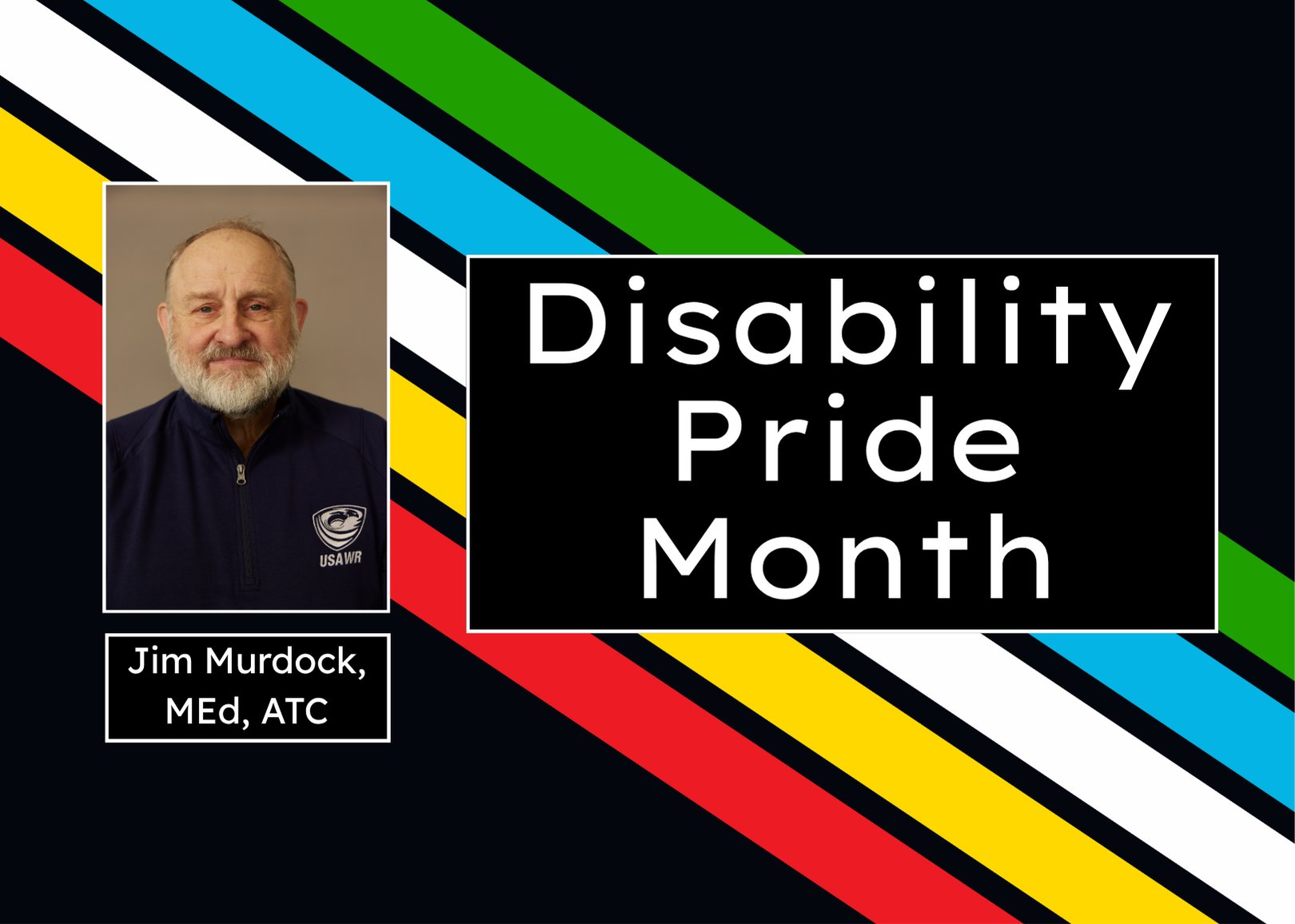
After the Americans with Disabilities Act was signed into law July 26, 1990, Disability Pride Month was created to commemorate this landmark law prohibiting discrimination against people with disabilities and ensuring accessibility in public life. In honor of Disability Pride Month, which features the theme “The World Works Better With Us” this year, NATA Now is highlighting members of the NATA Accessibility Panel throughout July.
In 2024, the NATA Accessibility Panel was created as part of the NATA Diversity, Equity, Inclusion and Accessibility Council to support the advancement of NATA’s commitment to fostering a more accessible and inclusive environment for members and patients with disabilities.
Jim Murdock, MEd, ATC, was asked to chair the panel as it got off the ground. Murdock’s first foray into volunteering with NATA began in 1992 with the College and University Committee Task Force; however, his volunteer journey within the profession began much earlier than that.
“I helped start the student AT club [at the University of New Hampshire] and did outreach to local high schools to assist in hiring full-time ATs,” he said.
Now, Murdock and the panel are working on developing guidelines and educational resources for members and their patient populations. Keep reading to learn more about Murdock, the impact volunteer leadership has had on him personally and professionally and his goals as Accessibility Panel chair.
What inspired you to pursue athletic training, and what was the moment you knew this was the profession for you?
I was introduced to athletic training in my first year at the University of New Hampshire. I was trying out for the football team, and at 5 feet, 11 inches and 165 pounds, I didn’t fare too well against 6-foot-3-inch, 230-pound running backs as a linebacker. The linebacker coach and head athletic trainer, Dwight Aultman, saw my enthusiasm but was kind enough to indicate football at the Division I level probably wasn’t in my future. Dwight asked if I had a work-study position and hired me as an athletic training student.
After my first year as an athletic training student, and experiencing the ability to combine athletics with health care, I was hooked.
What was your first volunteer position within the athletic training profession and why did you get involved?
My first volunteer position was as a student at UNH. I helped start the student AT club and did outreach to local high schools to assist in hiring full-time ATs.
Tell us about your current volunteer position on the NATA Accessibility Panel, why you joined the panel and what you hope to accomplish in this role.
Currently, I’m the chair of the Accessibility Panel. I was approached by District One Director Vicky Graham, DAT, LAT, ATC, and current NATA DEIA Council Chair Jen Sturtevant, MBA, LAT, ATC, and asked if I would be interested in assisting in putting the Accessibility Panel together. It wasn’t part of the DEIA Council at that time.
As chair, my hope is to identify how many members have a disability and/or work with a disability population. I also want to educate members about the disability population; what disabilities are; what rights people with disabilities have; how to interact, treat and care for people with disabilities; and promote accessibility and inclusion for ATs, their patients and students.
Why is representation in leadership important and how does it impact the profession?
My concept of leadership is helping others achieve their goals and improve their professional and personal development. I believe these are the tenets that help not only people, but organizations grow and improve for their members and the populations they may serve.
How has volunteering helped you grow personally and professionally?
Professionally, volunteering has afforded me the opportunity to meet many people in our profession and associated professions. This has greatly improved my knowledge and awareness of the profession as well as skills, dynamics and procedures others use.
Personally, I have been able to create many friendships and insight into others’ lives. It has also given me a true sense of stewardship and a rewarding sense of accomplishment.
What’s your fondest memory of serving so far?
This is a tough one. I have had many fond memories, but one is when serving on the NATA Governmental Affairs Committee and seeing how we were able to assist states financially in getting state licensure.
What advice do you have for other athletic trainers who want to give back to the profession?
Too often I hear from other ATs that they don’t have the skills or time to volunteer. I truly believe that everyone has the ability and capacity to do something for the profession. Often people are looking for the “big” input, but it’s the accumulation of many small efforts that make a difference in change.