Showing Up for the Profession
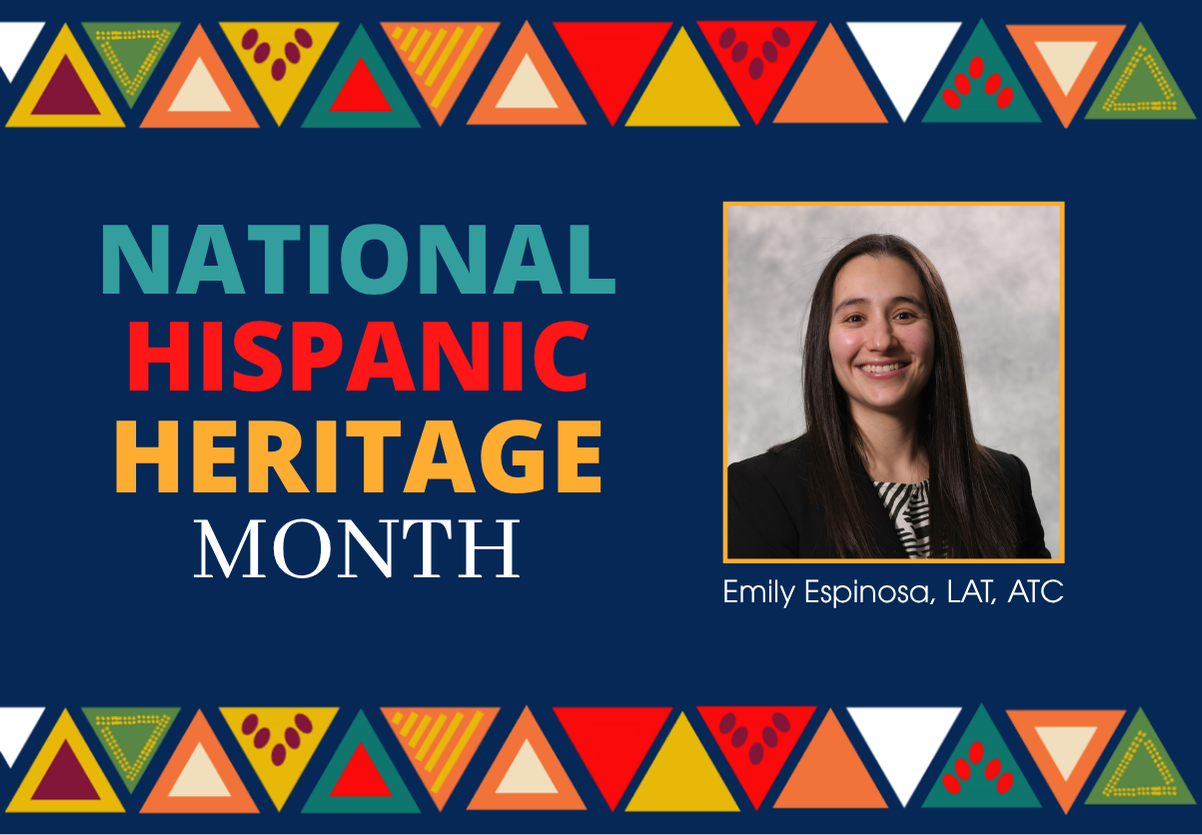
In honor of National Hispanic Heritage Month Sept. 15-Oct. 15, NATA Now, in collaboration with the NATA Ethnic Diversity Advisory Committee, is highlighting some of our state, district and national leaders and sharing insight into their drive to give back to the profession.
When Emily Espinosa, LAT, ATC, first got involved with the Illinois Athletic Trainers’ Association, she was simply looking for a way to get her feet wet as a volunteer.
A recommendation from her boss led her to the IATA Council for Early Career Athletic Trainers, which then led to her current position on the IATA Board of Directors as the Region 1 representative. Along the way, volunteering has helped Espinosa develop leadership skills, advocate for athletic trainers and see the profession from a broader perspective.
“The people I have met along the way are what gives me the inspiration to continue volunteering,” she said. “We are doing great things for the profession and having fun the whole time we are doing it. What more could you ask for?”
In this Q&A, Espinosa shares how volunteering has helped her grow as a leader, why representation in leadership matters and how other ATs can get involved.
What inspired you to pursue athletic training, and what was the moment you knew this was the profession for you?
I grew up in Chicago and went to Lane Tech College Prep High School, which is the largest Chicago Public School, and we had one athletic trainer. The sport I played – softball – was played off campus at a local park district field, so our one athletic trainer for 1,000-plus athletes never made it to a single game.
I truly knew nothing about athletic training going into college because my experience was pretty much nonexistent. However, I did know that I wanted to do something in the medical field and loved sports. I saw that Lewis University, the university I planned to attend and play softball at, had athletic training as a major. I decided to take the introductory courses to see if it was something I could see myself doing as a career. As soon as I started my first clinical rotation, I knew athletic training was going to be something I liked and would grow to love.
The moment I knew that this profession was one I loved and would stay in for the long run was actually two years into being an athletic trainer. I already enjoyed the profession, but that year, I was able to develop strong relationships with the athletes on my school’s girls’ soccer team. They were a needy bunch but were also very respectful, very talented and wanted to get healthy, which made them fun to watch. I remember driving home one day from work and thinking, “Man, I can’t wait to go back and do this all over again tomorrow.”
What was your first volunteer position within the athletic training profession and why did you get involved?
The first volunteer position I got involved in was on Illinois Athletic Trainers’ Association Council for Early Career Athletic Trainers. My boss told me he thought getting involved in the profession was really rewarding and that I would enjoy it. So, I decided to look into joining a committee just to get my feet wet, and CECAT just made sense. Soon after, I joined, the co-chair position became available. I had decided by then that I really did enjoy volunteering and that being involved was something I also believed was important. I knew I wanted to actively help the profession continue to grow from the frontlines, so I applied for the CECAT co-chair position and was appointed to the position at the next board meeting.
Tell us about your current volunteer position and what you hope to accomplish in this role.
Currently, I’m the Region 1 representative on the IATA Board of Directors. My goal in this role is to engage with the Region 1 athletic trainers, hear their concerns and questions and show them how they’re supported by their state professional organization. Many athletic trainers don’t see the value in their state professional organization, and I feel that this is truly unfortunate and incorrect. There is a knowledge gap/misunderstanding, and the region representatives can help the membership better understand what they are missing. It’s our job to help show the value of your state and national organizations by providing local services, such as continuing education events, networking socials and other events that educate the public about the profession.
Why is representation in leadership important and how does it impact the profession?
Representation in leadership is important because it inspires people like you to believe in themselves and want to become a leader. Seeing leaders that look like you makes the idea of one day becoming that leader realistic and attainable. We want people from all different backgrounds and ethnicities in leadership because diversity provides perspective for the profession. Often, we don’t know what we don’t know, and having a supporting leadership group with representation of different backgrounds and ethnicities helps expose those knowledge gaps and makes us and the profession better and stronger.
How has volunteering helped you grow personally and professionally?
Volunteering has helped me grow personally by making me a better person overall. It’s very easy to just do everything for yourself, but when you get into volunteering for your professional organization, it makes you realize that this profession is more than just a paycheck that comes in every two weeks.
In the secondary setting, I have daily interactions with a population that is very impressionable. High school students need guidance on many levels and, at the very least, we’re showing them what high-quality health care can do for them. In order to do that, athletic trainers need a reliable state organization that will advocate for them. Being a part of that state organization has made me more selfless, which helps not only my patients but my husband and family.
Professionally, volunteering has helped me gain leadership skills that I might not normally have gotten until years later in my career. It provided me with a slow introduction to what is happening in the profession, it showed me how I could make a difference and how I could advocate for not only myself but all athletic trainers in my state. It has helped me become a young leader in the state of Illinois for athletic trainers.
What’s your fondest memory of serving so far?
My fondest memory of serving so far is of the relationships I have made with other athletic trainers who volunteer. The people I have met along the way are what gives me the inspiration to continue volunteering. We are doing great things for the profession and having fun the whole time we are doing it. What more could you ask for?
What advice do you have for other athletic trainers who want to give back to the profession?
My advice to athletic trainers who want to give back to the profession is to reach out to their state organization and volunteer for something small, such as being a member of a committee. This will allow you to start your journey at a very low level of commitment. You can see if volunteering is something that fits in with your professional and personal life. Even positions with low time commitment have extreme value to each state organization and can make a positive impact on the organization.