Advocating for the Unseen
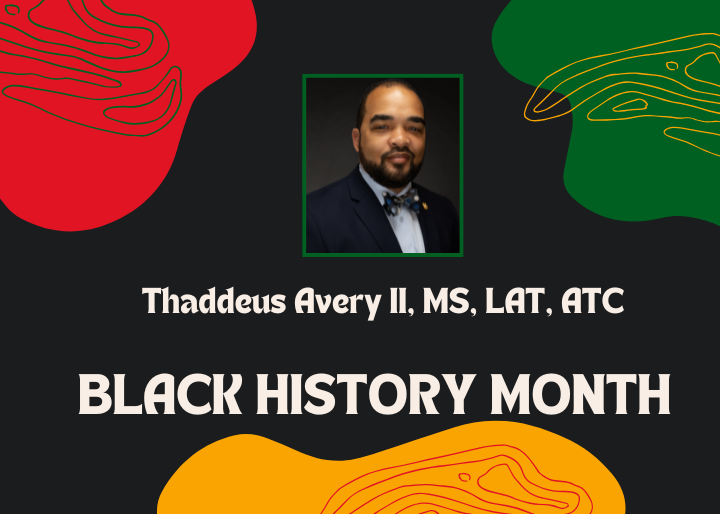
In honor of Black History Month in February, NATA Now, in collaboration with the NATA Ethnic Diversity Advisory Committee, is highlighting some of our Black leaders at the state, district and national levels, providing insight into the impact they are making on the profession.
A product of mentorship himself, Thaddeus Avery II, MS, LAT, ATC, has become a passionate advocate for service.
As the first African American vice president of the Tennessee Athletic Trainers’ Society, Avery’s path to leadership was stoked by tenacious mentors.
“I initially got involved because I had a few people – both athletic trainers and non-ATs – who made it their business to mentor me because they saw some potential in me before I was able to see it in myself,” he said.
Although Avery describes himself as a reserved person, he said he has embraced volunteerism as a door to networking and advocating for the profession.
Read on for more insight into his professional beginnings and leadership development.
What inspired you to pursue athletic training, and what was the moment you knew this was the profession for you?
Initially, I went to school for physical education because I wasn't sure of what I really wanted to do. While as an undergraduate student at Tennessee State University, I kept walking by the school’s athletic training facility door, and was one day finally stopped by Monroe Abram, MEd, LAT, ATC, and Eric Williams, LAT, ATC. After a few days of grilling and checking my character, they introduced me to athletic training. I knew this was the profession for me after Monroe took extra interest in me and got me into the athletic training education program at the University of Arkansas.
What was your first volunteer position within the athletic training profession and why did you get involved?
My first opportunity to serve as a volunteer for the Tennessee Athletic Trainers’ Society came as the West Tennessee representative was leaving the area and changing professions. I was asked to simply finish up his one-year term as representative. After a year of service, I was asked to serve again and that began my journey of volunteer service to the state of Tennessee. I served as the West Tennessee representative for six years. I initially got involved because I had a few people – both athletic trainers and non-ATs – who made it their business to mentor me because they saw some potential in me before I was able to see it in myself.
Tell us about your current volunteer position and what you hope to accomplish in this role.
Currently, I'm the vice president of TATS. My main responsibilities include the organization of the annual TATS Annual Meeting and Symposium – taking place May 29-31 at Battle Ground Academy in Franklin, Tennessee – and serving as a board liaison to several committees within TATS. During my tenure as vice president, I hope to assist with a few things. The largest goal is to assist with updating our state's practice act. It's been more than 20 years since we've made any major modifications to it. Since the profession has evolved drastically within that time, we've got to get our capabilities and permissions updated as well. I'd be extremely proud to know that I played a part in such an accomplishment.
Why is representation in leadership important and how does it impact the profession?
Representation is essential because it's a great display of the versatility within an area. In Tennessee, we've got a solid amount of diversity within the athletic training community. Having the opportunity to have a seat at any table of significance is key to making quality considerations for everyone who can or would be affected by the decisions made for the greater good. In the world of athletic training, I believe representation would certainly highlight our profession even more because it gives a larger scale image of athletic trainers in every walk of life. This would not only include the different settings, but also show that the profession has evolved to having a motivational influence in multiple ethnic diversities. This could also show the youth of various communities the possibilities that could lie in front of them as far as career paths are concerned.
How has volunteering helped you grow personally and professionally?
Both personally and professionally, volunteering has allowed me to break out of my normal shell. I'm naturally a reserved and quiet person. Most people who know me understand I'm the kind of person who only speaks when it's necessary, not because the opportunity is available. The volunteering opportunities I've been afforded to participate in have given me the chance to network with others across the country and learn how to embrace a more outgoing personality.
What’s your fondest memory of serving so far?
Knowing that I'm the first African American vice president in TATS is the greatest memory I'll always have. I hope that setting that standard will provide others with the confidence to believe they can achieve this type of accomplishment and the responsibilities that go with it.
What advice do you have for other athletic trainers who want to give back to the profession?
I live my life of service based upon this quote by the legendary Muhammad Ali: “Service to others is the rent you pay for your room here on earth.” Don't be afraid to give back in general. While I know this question is geared toward athletic training, it’s an important topic to always consider. Sometimes, the smallest gestures can have the largest influence. Now, from an athletic training perspective, giving back is just an opportunity to make the profession better for the next generation of ATs to work in. Find a way to give back that best fits your personality such as mentoring, committee involvement, educational advancements, etc., and it'll always make an impact.