From Being Led To Being a Leader
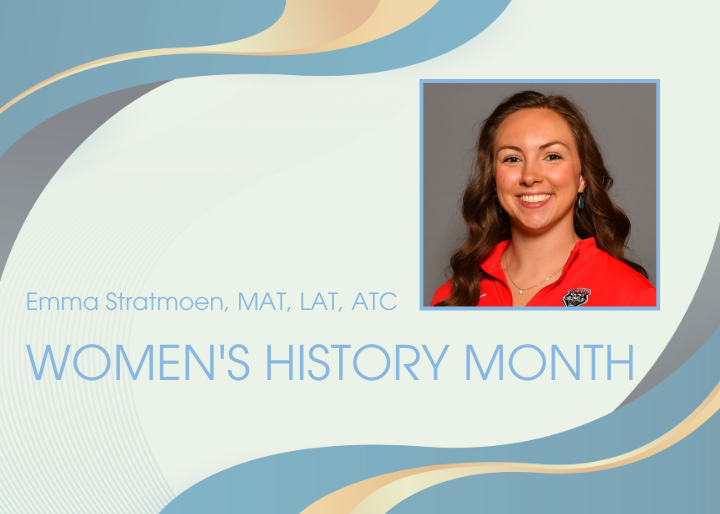
In honor of Women’s History Month this March, NATA is highlighting women leaders who are working to advance the athletic training profession at the state, district and national levels.
NATA Early Professionals’ Committee Chair Emma Stratmoen, MAT, LAT, ATC, said she walks in the footsteps of strong female mentors who model the value of giving back to the profession.
From NATA Athletic Training and Public Health Committee member Heather Hudson, EdD, LAT, ATC, who prompted her to seek ways to volunteer and balance leadership with personal goals, to inaugural EPC Chair Emily Mulkey Swisher, MBA, MS, ATC, who guided her through professional challenges, impactful women have helped hone Stratmoen’s leadership values.
“I have been so fortunate to have witnessed women in leadership throughout my career from a student to now in my later early career days,” Stratmoen said. “I’m thankful for the ways these women have pushed me to grow as an athletic trainer and a leader. I wouldn’t be who I am without each of them.”
Now serving as a committee chair, Stratmoen said she aims to expand resources, foster community and encourage early career involvement in the profession, as she continues to advance as a leader.
Read on to learn more about Stratmoen’s leadership development and her efforts to build more leaders.
What was your first leadership position within the athletic training profession and what inspired you to become a leader?
As a student, I was involved in my college’s student athletic training association in a communications role and promoted the organization on social media. When I became certified, I first got involved with the NATA Research & Education Foundation’s Educational Resources Committee, which I still serve on. I was invited to join the New Hampshire Athletic Trainers’ Association, also in a communications role, building the brand and promoting events and the work of NHATA on social media. I have been fortunate to have many female mentors who’ve modeled professional service to me in many stages of my life. I’ve seen how it benefited them personally and professionally, and I’ve already seen the benefits of professional service in my young career. I hope to similarly model service to those I mentor and be in the room where important conversations are happening to help shape the future of our profession.
Tell us about your current leadership position and what you hope to accomplish in this role.
I’m honored to be the current chair of the NATA Early Professionals’ Committee. We are a young committee, founded in 2021, and seek to serve athletic trainers within their first six years of certification. Our committee’s primary charge is to aid in transition to practice and bridge the gap between the classroom and your first full-time role. We hope to provide easily accessible resources, foster community and help encourage early career professionals to get involved in professional service. In my tenure, I’m specifically hoping to expand the awareness of our committee and the incredible work our members do to become the go-to resource for athletic trainers when they enter the workforce. Additionally, I want to establish a strong research pipeline within our committee. I believe contributing to athletic training literature can feel daunting for early career professionals, but getting involved can make a significant impact on their own careers and the profession as a whole.
Why is representation in leadership important and how does it impact the profession?
Representation is crucial to encouraging people to get involved in professional service. I have leaned into these opportunities because they were modeled to me by my mentors. To see people, especially women in the field whom I look up to, thriving in their leadership roles while also excelling in their work and home lives, gives me the encouragement I need to stay involved and seek ways to continue growing in leadership. A leadership book I read last year mentioned that people need to be led by people who are better leaders than they are, or you’ll lose the traction of the people you’re leading. Seeing those before me advance themselves as leaders has encouraged me to actively pursue my own growth, creating a trickle‑down effect to the people we lead and for generations to come. If we can look ahead to people who lead better than we do and seek to develop ourselves, we will all raise the ceiling of what’s possible. In doing so, we can make even bigger waves in our profession and in the greater world of health care.
Who are the women in the profession who have inspired or mentored you in your leadership journey?
I have been so fortunate to have witnessed women in leadership throughout my career from a student to now in my later early career days. I’m thankful for the ways these women have pushed me to grow as an athletic trainer and a leader. I wouldn’t be who I am without each of them.
Heather Hudson, EdD, LAT, ATC, encouraged me as a student to look for ways to get involved. She continues to encourage me to stay aligned with my goals, seek out opportunities that work with them and balance them with my personal life goals.
Sandy Snow, MS, NHLAT, ATC, is the woman who “volun-told” me to get involved in NHATA and seeks out ways to always effect positive change in her environment.
Summer Bloom, MS, ATC, is someone so fiercely committed to being a lifelong learner, growing her craft and our profession through many avenues, and is excited to see women paving a new way for our field.
Emily Mulkey Swisher, MBA, MS, ATC, was the first EPC chair and someone who has mentored me through career uncertainty and professional service. She continues to be someone I can count on for wise counsel and trustworthy advice.
How has leadership helped you grow personally and professionally?
Leadership has challenged me to grow my active listening skills and ability to empathize with others. It can be easy, as a leader, to set an agenda, outline the objectives and create goals for your group based on your timeline. However, it’s important to remember that those serving with us exist in different practice settings with different seasonal demands and their own personal challenges too. Professionally, the administrative and project management skills I’ve developed through leadership roles have allowed me to advance in my practice setting because I’ve demonstrated the ability to oversee more complex administrative tasks and projects. Additionally, the people I’ve met through my roles in professional service have provided wise counsel, feedback and direction as I’ve sought out new roles, navigated interview processes and considered the path I want to take in professional service.
What’s your fondest memory of serving so far?
I’ve greatly appreciated the opportunity to network and get connected to so many incredible athletic trainers through professional service and spend time together at conferences and meetings. One of my highlights was Committee Day during the 76th NATA Clinical Symposia & AT Expo in 2025. We had many EPC members rolling off after completing their term as inaugural members of the committee, and just as many new members beginning theirs. It was an honor to hear the inaugural committee members reflect on the progress made during their tenure, and to hear our new committee members begin to consider the legacy they hope to leave during their time on the committee.
What advice do you have for other athletic trainers who want to give back to the profession?
Depending on your network, there can be a lot of negative chatter about the athletic training profession on social media. I find it refreshing to connect and fill my feed with those who are optimistic about the future of our profession and committed to doing the work to get there. Those involved in professional service, in my experience, have a more positive outlook on the profession and serving is a great way to not only highlight your strengths, but also grow in your areas of opportunity. While it’s a time commitment, the return, for me, has been worth the time invested 10 fold in the way it’s bettered me not only as an athletic trainer, but also as a person.