Shaped by Service
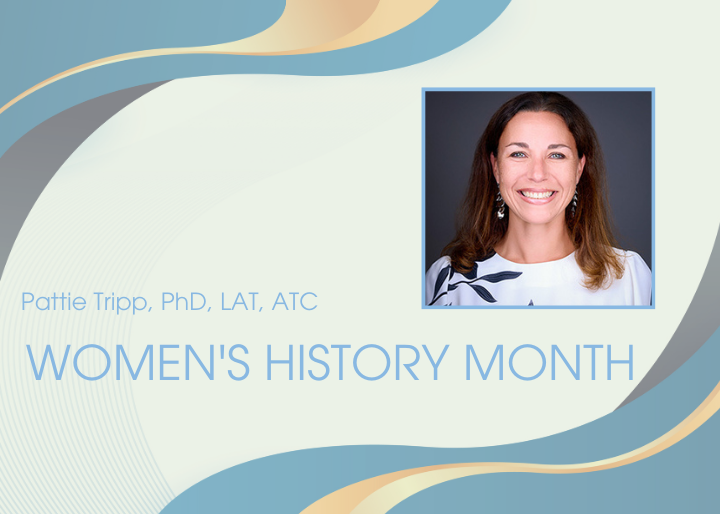
In honor of Women’s History Month this March, NATA is highlighting women leaders who are working to advance the athletic training profession at the state, district and national levels.
Southeast Athletic Trainers’ Association President Pattie Tripp, PhD, LAT, ATC, said she developed a desire for service during her undergraduate years at the University of Florida.
“I have been a member of NATA since I was a 17-year-old freshman in college,” she said. “As an athletic training student, my mentors cultivated my passion for involvement.”
Since college, Tripp has witnessed firsthand the importance of service within athletic training. Attending events such as the Athletic Trainers’ Association of Florida Hall of Fame induction of Chris Patrick, AT Ret., and observing the involvement of faculty leaders including MaryBeth Horodyski, EdD, LAT, ATC, and Thomas Kaminski, PhD, ATC, FNATA, left a lasting impression on her.
With several leadership experiences under her belt, Tripp said her involvement continues to impact the profession today.
Learn more about how Tripp’s leadership journey has deepened her engagement in the profession and strengthened her commitment to its advancement.
What was your first leadership position within the athletic training profession and what inspired you to become a leader?
I started out as an ATAF Educational Programming Committee member in 2009. In 2012, I became the District Nine director of the NATA Research & Education Foundation, after which I served as vice president of the Athletic Trainers’ Association of Florida in 2015.
Serving within our profession has been something I’ve seen modeled since my time as an undergraduate student at the University of Florida. I recall attending the ATAF Hall of Fame induction Ceremony for Chris Patrick, AT Ret., honoring him for his role within ATAF and the impact he had on NATA, the Southeast Athletic Trainers’ Association and the Board of Certification for the Athletic Trainer. I saw my faculty – MaryBeth Horodyski, EdD, LAT, ATC, and Thomas Kaminski, PhD, ATC, FNATA – present, engage and promote involvement during SEATA’s Athletic Training Student Symposium. Service is part of our professional responsibility as ATs, and my undergraduate experience helped shape that foundational expectation.
Tell us about your current leadership position and what you hope to accomplish in this role.
I serve as president of SEATA. I began my role with our current leadership team in June 2024. I had served on the SEATA Executive Board as president of ATAF for three years. So, when I began the role of leading the district, I had organized a list of projects, goals and initiatives, and we hit the ground running. We have a fantastic team of people who truly love our profession, and we have a shared purpose toward collaboration and progress. In the first 18 months of my first term as SEATA president, we accomplished a lot. We overhauled the infrastructure (e.g., new committees, organizational communication) of SEATA so it could function in support of all members. We revised our vision, mission, core values and goals. We updated our constitution and bylaws to reflect the present work of our association. We updated our policies and procedures document to capture the shared expectations of our leadership team in alignment with our new strategic priorities. We updated our BOC-approved Provider Handbook and changed our learning platform for our symposium to refresh our approach to delivering high-quality continuing education for our members. We created a balanced operational budget, negotiated a financially sound symposium contract for our annual educational meeting and overhauled our website so that our external branding would be consistent with our identity as an association. So far, we have accomplished all that we set out to do.
Why is representation in leadership important and how does it impact the profession?
I believe representation and role modeling are critical in leadership, because representation allows students and young professionals to see themselves in situations and know what’s possible. I never doubted that I had the ability to impact our profession because I saw women working in all aspects of athletic training, opening opportunities in clinical practice settings, educational programs and leadership roles. I had the privilege of never knowing otherwise.
Who are the women in the profession who have inspired or mentored you in your leadership journey?
- MaryBeth Horodyski, EdD, LAT, ATC
- Marisa Brunett, MS, LAT, ATC
- Sue Stanley-Green, MS, LAT, ATC
- Stephanie Lennon, MS, LAT, ATC
- Mary Kirkland, MS, LAT, ATC
- Kathy Dieringer, AT Ret.
- Kristen Schellhase, EdD, LAT, ATC
- Karen Lew Feirman, DHSc, LAT, ATC
- Valerie Moody, PhD, LAT, ATC
- Shelly DiCesaro, PhD, LAT, ATC
How has leadership helped you grow personally and professionally?
I love being involved and working with colleagues at the state, regional and national levels. I have learned so much as a leader and mentor and expanded my network exponentially through service. I’m a better educator, mentor and network builder for my students because I choose to serve within our profession. Athletic training is a people-centric profession, and I believe volunteering on committees and boards within our profession helped shape the lens through which I see our profession impacting the conversation around health care access and delivery.
What’s your fondest memory of serving so far?
Two of my favorite experiences within my professional service have been acting as a member of the NATA International Committee and serving as ATAF president. As a member of IC, I was part of a wonderful team of people led by NATA Hall of Famer Mark Gibson,MSEd, MS, AT Ret., who helped shape the strategic priorities and 10-year direction of NATA globally. Being able to look beyond our borders and learn about how ATs can impact global health and sports medicine was truly amazing. During that same time, I was on the NATA Research & Education Foundation Board of Directors, serving with the Educational Resources Committee, and we were able to blend our efforts to create multi-language infographics that ATs could use for patient resources.
Being ATAF president and serving on the ATAF Executive Board has been one of my proudest experiences. I had served as ATAF vice president for six years prior to my election as president. We wanted to create a community within ATAF that cultivated talent (a deep bench) of volunteers who could maintain the upward trajectory of growth within Florida. We have highly engaged and passionate people across Florida. Two of the most impactful experiences during my tenure as ATAF president include the collaboration with the Florida Board of Athletic Training to update the scope of practice (administrative code), so that ATs in Florida could practice at the top of their skill set, and working with the Sports Medicine Advisory Committee of the Florida High School Athletic Association to update their policies to align with best practices outlined by the Korey Stringer Institute.
What advice do you have for other athletic trainers who want to give back to the profession?
Be persistent, offer to help in areas of the profession where you feel passion and purpose and expand your network. I have been a member of NATA since I was a 17-year-old freshman in college. As an athletic training student, my mentors cultivated my passion for involvement. I would encourage ATs to champion student involvement in our association in whatever manner available; be it a preceptor, mentor, faculty/educator or role model. Get involved at the local level in your community, engage administratively with your employer, volunteer with your state association and stay current with the resources available from NATA and the AT Strategic Alliance partners. Being engaged in our profession offers ATs the power to change and improve aspects of our profession that need attention and growth. Change is difficult and it requires patience and consistency. Be willing to show up, have a conversation and share in the responsibility to make tomorrow better than today.